Dead Man
After becoming a major advocate of American independent filmmaking during the late 80's/early 90's, and joining the ranks alongside such other directors as Spike Lee, The Coen brothers, Richard Linklater and Quentin Tarantino as non-conformist filmmakers who's movies often evade the mainstream spotlight, Jim Jarmusch followed his succession of minimalist features by experimenting with colour filmmaking for a brief period with his two films Mystery Train and Night On Earth, both linked by their triptych formats (a style later revisited in 2003's Coffee and Cigarettes).
After a nine year period, Jarmusch revisited black-and-white cinema with his 1995 film Dead Man, an existential Western set in late-19th Century America, starring Johnny Depp as 'William Blake', a greenhorn from the East who's journey to the West via. train represents a transition from one life, into the next. With his destination being the frontier town of 'Machine', his arrival is met sorely, and his shooting of the wealthy town-owner's son causes him to flee injured into the wilderness, where he encounters American-Indian 'Nobody' attempting to dislodge a bullet from his heart, unable to do so, and believed by 'Nobody' to be a reincarnation of the English poet William Blake, Blake is informed that he is the walking dead, starting his journey into unfamiliar territory with the guide of his unconscious mind 'Nobody'.
With American-Indian 'Nobody's' passion of the poetry of William Blake bearing similarities in it's juxtaposition of culture to Jarmusch's 1999 feature Ghost Dog: The Way of the Samurai, in which a black hit-man expresses a complete devotion to the 18th century philosophical and spiritual warrior code of the Hagakure, the hallmarks of Jarmusch's films are as apparent in Dead Man, as in any of his various other directorial works, with themes of estrangement from a character's native land and alienation becoming recurrent topics throughout his career. Dead Man's black-and-white imagery is a conscious effort by Jarmusch to abandon the dusty aesthetic of the Western genre and an attempt to gain a historical distance from the familiarity of colour, drawing influence from directors such as Akira Kurosawa, Kenji Mizoguchi and Ingmar Bergman, using very strong blacks and whites and placing emphasis on lighting and placement.
Neil Young's instrumental score lifts the movie to an entirely different level, using a pump organ, a detuned piano, and most notably electric guitar tracks and feedback to create a strong unsettling and deeply emotional soundtrack that fits perfectly with the themes of the film. Jarmusch's output as a director is inconsistent to say the least, and criminally so, producing only ten feature length movies in a career spanning over thirty years, forgivable, considering his almost flawless oeuvre, in which he has managed to maintain his originality, and creative spirit in an industry rife with studio meddling and compromise.
words by danny walker.
The Bad Sleep Well
Akira Kurosawa, 1960
Kurosawa would adapt the work of Shakespeare to the screen three times over the course of his career resulting in three of his best works. The two that would receive more attention would be the first, Throne of Blood an adaptation of Macbeth, and his take on King Lear, 1985’s Ran. With their historical setting these were obvious choices to make the transposition to the feudal Japan that Kurosawa would bring to the screen through his most famous works. Lesser known, and much more loosely adapted than those previously mentioned, is his take on Hamlet- The Bad Sleep Well.
It is a loose adaptation firstly as a result of Kurosawa’s choice to set it in contemporary Japan, and for the replacement of kings and queens with their modern equivalent, the rich chairmen of giant corporations. The film follows the story of Nishi (played by Kurosawa regular Toshiro Mifune) as he marries the daughter of wealthy industrialist Iwabuchi in an attempt to avenge the death of his father, of which he believes Iwabuchi and his corporation are to blame. It’s primarily in the driving motive of the main character that the plot similarities are found, however there are flourishes reminiscent of the play to be found elsewhere, for example the brilliant opening sequence. Whereas in Hamlet the protagonist stages a play referencing his fathers murder, watching for the kings reaction to the scene to ascertain whether he did commit the crime, here Nishi has a cake delivered to Iwabuchi at Nishi’s own wedding reception, it is shaped like the company headquarters with a rose marking the window from which his father met his death. Upon it’s arrival the reactions of the senior executives lead anyone watching, including the paparazzi who linger around this scandal ridden company, to the realisation that they are most definitely implicated.
Kurosawa had tackled corruption before, most notably in Ikiru although that was on a much smaller scale simply regarding one council office. Here he takes it right to the top with top boss Iwabuchi receiving anonymous instruction over the phone, with it only hinted at in the mildest way that this caller is some political figure and that the whole system is corrupt through to the top (a controversial suggestion Kurosawa was only able to make through financing the film by establishing his own production company). Between every high budget epic like Seven Samurai or The Hidden Fortress Kurosawa would punctuate with these smaller more personal ‘message’ films such as The Bad Sleep Well or his anti nuclear film I Live in Fear. It’s a great approach and it’s influence is apparent in the careers of directors such as Spielberg and Scorsese with their ‘one for them, one for me’ philosophy. Despite being less grandiose these films stand as some of Kurosawa’s best, the performances from his usual collaborators such as Toshiro Mifune and Takashi Shimura never fall short of greatness, and the widescreen cinematography, taking its cues from film noir with its use of light and shadow, give the film as epic a feel as ever.
words by pete bond.
It is a loose adaptation firstly as a result of Kurosawa’s choice to set it in contemporary Japan, and for the replacement of kings and queens with their modern equivalent, the rich chairmen of giant corporations. The film follows the story of Nishi (played by Kurosawa regular Toshiro Mifune) as he marries the daughter of wealthy industrialist Iwabuchi in an attempt to avenge the death of his father, of which he believes Iwabuchi and his corporation are to blame. It’s primarily in the driving motive of the main character that the plot similarities are found, however there are flourishes reminiscent of the play to be found elsewhere, for example the brilliant opening sequence. Whereas in Hamlet the protagonist stages a play referencing his fathers murder, watching for the kings reaction to the scene to ascertain whether he did commit the crime, here Nishi has a cake delivered to Iwabuchi at Nishi’s own wedding reception, it is shaped like the company headquarters with a rose marking the window from which his father met his death. Upon it’s arrival the reactions of the senior executives lead anyone watching, including the paparazzi who linger around this scandal ridden company, to the realisation that they are most definitely implicated.
This opening sequence highlights one of Kurosawa’s real strengths as a director, his ability to balance so much of a film around a single locale. As one of the paparazzi at the wedding observes it’s like watching ‘a one act play’ and with Kurosawa’s ability to condense such a large amount of story into one scene, along with his penchant for framing all his characters within the one shot, it does have its grounds in theatre, somewhere from his choice of source material he clearly takes inspiration. This on screen theatre is seen throughout various works of Kurosawa, examples being the apartment sequence that takes up a large part of High and Low or the extensive wake sequence in Ikiru. Large amounts of story and character exposition occur purely through the dialogue, the performances, and the fantastic use of the score managing to build the tension.
Kurosawa had tackled corruption before, most notably in Ikiru although that was on a much smaller scale simply regarding one council office. Here he takes it right to the top with top boss Iwabuchi receiving anonymous instruction over the phone, with it only hinted at in the mildest way that this caller is some political figure and that the whole system is corrupt through to the top (a controversial suggestion Kurosawa was only able to make through financing the film by establishing his own production company). Between every high budget epic like Seven Samurai or The Hidden Fortress Kurosawa would punctuate with these smaller more personal ‘message’ films such as The Bad Sleep Well or his anti nuclear film I Live in Fear. It’s a great approach and it’s influence is apparent in the careers of directors such as Spielberg and Scorsese with their ‘one for them, one for me’ philosophy. Despite being less grandiose these films stand as some of Kurosawa’s best, the performances from his usual collaborators such as Toshiro Mifune and Takashi Shimura never fall short of greatness, and the widescreen cinematography, taking its cues from film noir with its use of light and shadow, give the film as epic a feel as ever.
words by pete bond.
The Discreet Charm of the Bourgeoisie
Having given birth to surrealist film with his debut, the silent short Un Chien Andalou, co directed by his close friend Salvador Dali, Buñuel would continue to make ever more comic and absurd films satirising the middle classes and the church for over another 40 years. Not losing any of his edge toward the end of his career 1972 would see the release of what is arguably his best work, and the film for which he won an Oscar, The Discreet Charm of the Bourgeoisie.
The premise of the film is simple, a group of friends representing various middle class establishments attempt to eat dinner together only to be interrupted in ever more bizarre ways. The first night they attempt to have their dinner party the guests simply arrive on the wrong night, however as the film progresses intrusions from everyone including the military and the police continue to make their simple goal impossible. The tone of the film is Kafkaesque, filmed and acted in a realist manner with ever more absurd obstacles holding the characters back without them ever questioning the validity of the challenges they have to face.
For Buñuel the middle class and it’s prejudices and hypocrisies have often been a target of his work and the dinner party, being the archetypal form of bourgeois entertainment is the perfect setting for him to attack. Most prominently there was The Exterminating Angel with its story of guests who attend a dinner party and are totally unable to leave, his best use however remains in the sequence from The Phantom of Liberty where the guest sit around the dining table on toilets, excusing themselves and retiring to a bathroom stall to eat their food. It’s an idea other directors have examined too with films such as Marco Ferreri’s La Grande Bouffe in which a group of rich men retire to a country manor with the intention of eating themselves to death.
The significance of the dinner party for Buñuel is that it is a time when manners and decorum are at the absolute forefront, the characters in the film are all trying their best to appear socially acceptable meanwhile they are all secretly involved in everything from adultery to drug smuggling. It’s all about exposing the hypocrisy of it all, that these people devoid of morals feel superior simply due to their understanding of social etiquette. For example in one scene whilst the guests chastise their chauffer for not sipping his Martini correctly the hosts have vacated their own party via a window to have sex in the bushes outside their home. The interruptions they face throughout their meal frequently reflect the true nature of the characters, as though despite their best attempts the elements of their personality they are attempting to repress simply cannot be restrained from entering the scene.
Tonally it rests in between Buñuel’s other great films- the significantly more incomprehensible Un Chien Andalou and the more realist Belle de Jour, finding the perfect balance between the two approaches. With surrealist film analysis of the underlying message all too often becomes the focus, in doing this it is easy to neglect discussing the film simply on an enjoyment level. The Discreet Charm of the Bourgeoisie is a very accessible film, and although it is obviously never aiming for belly laughs is still very much a comedy, a brilliant comic satire from one of the all time greats of European cinema.
words by pete bond.
The premise of the film is simple, a group of friends representing various middle class establishments attempt to eat dinner together only to be interrupted in ever more bizarre ways. The first night they attempt to have their dinner party the guests simply arrive on the wrong night, however as the film progresses intrusions from everyone including the military and the police continue to make their simple goal impossible. The tone of the film is Kafkaesque, filmed and acted in a realist manner with ever more absurd obstacles holding the characters back without them ever questioning the validity of the challenges they have to face.
For Buñuel the middle class and it’s prejudices and hypocrisies have often been a target of his work and the dinner party, being the archetypal form of bourgeois entertainment is the perfect setting for him to attack. Most prominently there was The Exterminating Angel with its story of guests who attend a dinner party and are totally unable to leave, his best use however remains in the sequence from The Phantom of Liberty where the guest sit around the dining table on toilets, excusing themselves and retiring to a bathroom stall to eat their food. It’s an idea other directors have examined too with films such as Marco Ferreri’s La Grande Bouffe in which a group of rich men retire to a country manor with the intention of eating themselves to death.
The significance of the dinner party for Buñuel is that it is a time when manners and decorum are at the absolute forefront, the characters in the film are all trying their best to appear socially acceptable meanwhile they are all secretly involved in everything from adultery to drug smuggling. It’s all about exposing the hypocrisy of it all, that these people devoid of morals feel superior simply due to their understanding of social etiquette. For example in one scene whilst the guests chastise their chauffer for not sipping his Martini correctly the hosts have vacated their own party via a window to have sex in the bushes outside their home. The interruptions they face throughout their meal frequently reflect the true nature of the characters, as though despite their best attempts the elements of their personality they are attempting to repress simply cannot be restrained from entering the scene.
Tonally it rests in between Buñuel’s other great films- the significantly more incomprehensible Un Chien Andalou and the more realist Belle de Jour, finding the perfect balance between the two approaches. With surrealist film analysis of the underlying message all too often becomes the focus, in doing this it is easy to neglect discussing the film simply on an enjoyment level. The Discreet Charm of the Bourgeoisie is a very accessible film, and although it is obviously never aiming for belly laughs is still very much a comedy, a brilliant comic satire from one of the all time greats of European cinema.
words by pete bond.
American Boy: A Profile of Steven Prince
Martin Scorsese, 1978
Within his filmography, which spans just under half a century, a substantial part of Martin Scorsese's work encompasses certain reoccurring themes such as guilt, redemption and identity, and often features sociopathic, 'antihero' protagonists within such films as Taxi Driver and The King of Comedy. Between these two feature-lengths, and following the critical and commercial failure of New York, New York during a period of his life which was strewn with cocaine addiction and depression, he released American Boy: A Profile of Steven Prince a 55 minute documentary, the subject of which being the title character Steven Prince, a twenty-something Jewish gay man and close friend and roommate of Scorsese's, as he recounts memories from his time spent as road manager for Niel Diamond, and recites anecdotes of his experience with guns and drugs.
What differs American Boy from any of Scorsese's various other features, is it's notable absence of stylish camera-work or visuals, with Marty opting to act as more of an observer than a director, capturing Prince's stories on a truly basic level, and interweaving his anecdotes with home-movie footage of the Prince family. Whilst the documentary may lack the notable style that has become the hallmark of Scorsese films today, what relation it does have with the director's other feature-lengths is his concern for violent and destructive men during the 1970's and early 80's in such films as Raging Bull and Taxi Driver, the latter of which Prince cameoed in as 'Easy Andy', a fast-talking hand-gun salesman and drug dealer, a character not to far removed from his own persona.
Amongst the assortment of stories Prince shares with his on-screen friends and the viewer, what becomes abundantly clear is the influence this hard to obtain movie has had on various film-makers since it's release, most famously of which being Quentin Tarantino's re-enactment of Prince's anecdote in Pulp Fiction, of when he was forced to inject adrenaline into the heart of an overdosing women, with the help of a medical dictionary and a magic marker. Less notable is Richard Linklater's adaptation of Prince's story, in which he shot dead a man he caught stealing tyres from a gas station he was working at, in his 2001 animated feature Waking Life (which also featured a small cameo from Prince himself). Aside from influencing a generation of self-taught filmmakers, who's education in film was not learned in school, but by watching obscure features such as this one, American Boy: A Profile of Steven Prince remains as being an influential feature, from the one of the greatest living directors in the world.
words by danny walker.
The Rules of Attraction
Roger Avary, 2002
Attempts to bring the world of Bret Easton Ellis to the screen have seen mixed results. Adaptations such as Less than Zero lacked the humour of it’s source as well as feeling the need to heavily imbue it with a ‘message’ (and a contrived and simple message at that- drugs are bad). Most recently The Informers also lacked the teeth of it’s novel, omitting the various surreal sequences that punctuate Ellis text and toning down the violence that plays so heavily in his work. American Psycho was one of the only successes, delivering the more graphic elements of the novel whilst remembering that Ellis writes satire, and that it is all meant to be comic in its own dark way.American Psycho is a lengthy book with no real plot structure however, so the film acts as ‘greatest hits’ of the book, combining and condensing scenes down whilst trying to make narrative sense of it all. The most accurate adaptation of Ellis work, and allegedly his personal favourite, is one of the most underrated films of the past decade The Rules of Attraction.
The film follows three different students at the prestigious Camden College, an arts school for the over privileged, Paul Denton, Lauren Hynde and Sean Bateman (as in the younger brother of Patrick Bateman) played by Shannyn Sossamon, Ian Somerhalder and James Van Der Beek respectively, as they attend various parties and have various confused relationships with one another and a whole array of other students. All three are superb in their individual roles, it can only be due to the film being poorly received on it’s initial release that it failed to propel any of them to greater heights, it surely should have at least marked Van Der Beek’s transition from TV to film star.
The best feature in the film is the experimental approach director Roger Avary takes with his camerawork. There is for example, the opening sequence where the three main characters are introduced. The camera follows one to the conclusion of their introductory scene, before playing the footage in reverse, continuing to do so until it has past the point where the scene began whereupon it will revert back to playing forwards but begin following a different character. Difficult to construct but impressive to watch. This continues throughout the film, with two characters being followed in split screen until they meet, with both halves of the screen converging into one shot. Best known for sharing the writing credit for Pulp Fiction it is a shame that this, only his second film as director, would be the last Avary would choose to helm, opting to revert back to his previous role as screenwriter.
The most impressive combination of Avary’s directing with the acting ability of his cast comes in the introduction of Victor Ward, played by Kip Pardue, a frenetically paced account of a summer he spent travelling around Europe condensed into four minutes. For this Avary and Pardue embarked on a two week trip throughout the continent, with Pardue remaining in character for the duration, sightseeing, taking drugs, and sleeping with numerous women. Enough footage was shot for this brief sequence that Avary constructed an entirely separate movie from it, titled Glitterati. Avary claims however that due to the unethical nature of the film, with all the people and events in it being real, in it will never be released.
During the section of the sequence where Victor is in Italy he mentions the sound of a bomb going off, an allusion to Ellis masterpiece Glamorama in which Victor is the main character, a naïve model who becomes involved in a terrorist plot throughout Europe. Avary holds the rights to this book and has stated he intends to direct it. As the years pass the likelihood of this happening seem more and more remote, hopefully the delay is due to Avary struggling to adapt such abstract material, and to find funding for what we will be such an ambitious feature, as opposed to simply a diminished interest. Based on The Rules of Attraction if he does take on the film, it will be one to look forward too.
words by pete bond.
Even Dwarfs Started Small
Werner Herzog, 1970
One director whose vast spectrum of work has been criminally overlooked by a mainstream audience, but whose reputation as an outlandish filmmaker and wide output of feature-lengths has gained him a devoted cult audience is German director Werner Herzog. With notorious tales of his unconventional methods in filmmaking often matching the actual features themselves, from the famously chaotic production of Fitzcarraldo, to his legendary tumultuous working relationship with actor Klaus Kinski, these stories act almost as counterparts to the features. Following his debut film Signs of Life in 1968 and encompassed in commercial and critical acclaim, Herzog's next feature was released in 1970 to a largely disfavorable audience, branding him a 'fascist' due to themes within his film. Even Dwarfs Started Small follows a group of dwarfs, isolated in a desolate institution, as they rebel against their enforcers and cause considerable mayhem and violence.
words by danny walker.
Performance
The casting of musicians in acting roles has been a varied affair, often capitalizing on the success of the artist, and exploiting the target audience; fans of the musician's work. For the artist the transition from sound to vision could be a method of reinvention (Bjork in Dancer in the Dark) or a platform by which the performer can promote their music (Eminem in 8 Mile). With Performance, the alteration of Mick Jagger's career from lead singer of The Rolling Stones, to his first serious acting role, after appearing in Jean-Luc Godard's documentary Sympathy for the Devil, seems to be a genuine attempt at change, funneling Jagger's on-stage persona and renouncing that image throughout the course of the movie.
Originally completed in 1968, but released two years later after controversies surrounding the film's content (one executive's wife infamously vomited during a test screening), Performance takes place on the back-end of the 60's, following Chas (James Fox) a 'Performer': a violent member of an East-London gang. After finding himself overpowered and tortured in his own flat by order of his boss, Chas is forced to abandon his life of crime, and go on-the-run, finding refuge in a house owned by Turner (Mick Jagger), a reclusive hermit and former rock star. Although the pair clearly come from polar worlds, Chas deriving from a male-run heterosexual background, and Turner's indulgences into a hidden world of sex, in the form of a bi-sexual ménage à trois, and recreational drug use, their influence upon each other culminates towards the end of the film, with each character gaining qualities of the other, Turner abandoning his feminine appearance during a David Lynch-style dream sequence, in which he becomes the boss of Chas' gang, and performs an impromptu version of Memo from Turner, and Chas' transformation from virility to androgyny after consuming hallucinogenic substances.
Whilst Performance may run parallels to certain other British crime movies of the day, such as Get Carter or Brighton Rock in terms of theme, what places the film miles apart from it's gangster movie counterparts, aside from it's study of gender identity, is Donald Cammell and Nicholas Roeg's prominent directorial work, which blends various different styles and techniques together, from jump cuts to crash zooms, often with the camera focusing on inanimate objects and rapidly panning out to reveal the subject. Most notable of all, is Performance's use of the cut-up technique, a style often used in literature, most famously by William S. Burroughs, in which text is literally cut up and rearranged to create an altogether new text. This style works in the films favor, giving the impression that the character of Chas may be losing his mind, or perhaps exposing the audience to his and Turner's perspectives with the character's consumption of mind-altering drugs.
Whilst Mick Jagger's acting career has been somewhat diverse, appearing in Tony Richardson's poorly received Ned Kelly as the title character, and even being briefly cast alongside Jason Robards in an early production of Werner Herzog's Fitzcarraldo before the film was entirely re-shot (footage of which can be found in either Herzog's own documentary My Best Fiend, or in the Fitzcarraldo documentary Burden Of Dreams) Performance remains as Jagger's greatest feat in the world of acting. Whilst the demographic for Performance is arguably fans of The Rolling Stones (the poster for the movie boasts 'Mick Jagger and Mick Jagger') and released under a year after the huge success of Let It Bleed, the film is far more than a method of reinvention or a promotional platform for Jagger, it remains nonpareil, perfectly capturing the essence of the 'swinging sixties' along with the seedy underbelly of London, whilst the execution of the film is as experimental as the period it captures.
words by danny walker.
F for Fake
Orson Welles, 1973
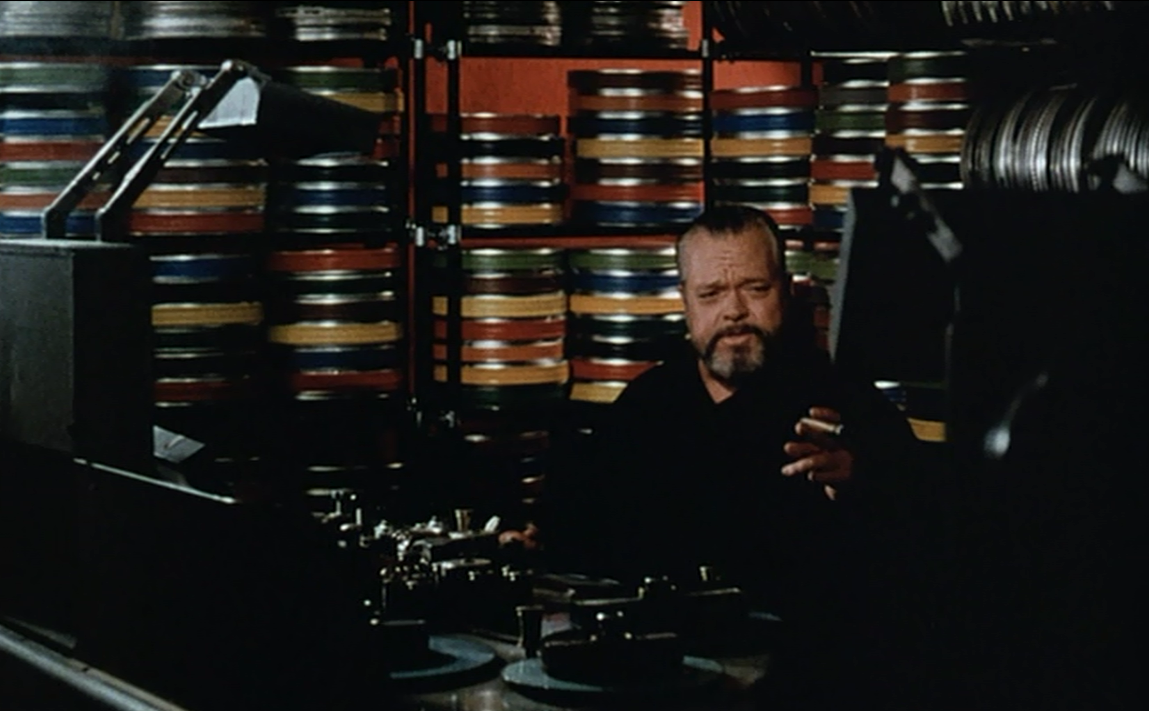
As Welles himself points out during the course of the film, his career began with a fake. This would be when he launched his infamous radio version of War of the Worlds, broadcasting it as though it were a genuine news report of Martians invading Earth, allegedly sending panic across America as people believed what they heard to be real (although whether this hysteria is true or simply a construction to give Welles and his show publicity remains unknown). It therefore seems fitting that his final feature would bring things full circle, with a documentary on the nature of forgery- F for Fake.
In a similar manner to a more recent film like Grizzly Man, large portions of the film were from a stock documentary that Welles discovered before reediting it with his own additional material. The initial focus of this documentary regards an art forger residing in Ibiza by the name of Elmeer de Hory, his villa here is paid for by an anonymous art dealer who he supplies with fakes to be sold on as the real thing, with many facts about himself, along with anecdotes about the sale of his work, supplied by his biographer Clifford Irving. Where Welles steps in and things become interesting, is that Irving himself was later jailed following the discovery that an official biography he had written on reclusive billionaire Howard Hughes was totally fraudulent (Irving himself claimed that he believed he really was working with Hughes on a biography, and that an impostor had in turn tricked him). This is the real focus of the film, if experts such as Irving and the art dealers who sell Elmeer’s work aren’t to be trusted as authorities, then who is?
Before Elmeer’s paintings are validated by an expert they are worthless, however once they receive their seal of approval they instantly become worth thousands. Similarly Irving was convicted on the grounds that a handwriting expert judged correspondence he had received from Hughes as being forged. If the experts can be mistaken in judging Elmeer’s fake’s as genuine, couldn’t they just as easily be wrong when they declare something genuine to be a fake?
Welles films is full of these sort of questions, and he cuts back and forward between them all at a frenetic pace helping to the create the confusion that is so clearly his goal. Stylistically it is in the editing that the film is at its most influential, with its fast pace created via frequent cuts and a very short length of shot. Self conscious as ever of what he is doing, the editing itself becomes one of the focuses of the film, often cutting back to Welles sat in an editing suite overseeing the footage and manipulating it to put across his point. As Godard once famously stated ‘every edit is a lie’, Welles knows this and ensures that it is every bit a feature of his film.
In Elmeer, Welles has a kindred spirit. He only began with forgery as means to fund his own paintings which he could not sell, similarly Welles would find himself resorting to starring in any film that came his was in a bid to fund projects such as F for Fake that no studio ever would. After this films completion, Elmeer would commit suicide following the decision by Spanish authorities to extradite him to France for prosecution. Despite his best efforts, and despite earning the AFI lifetime achievement award in 1975, Welles would not complete another film in the decade leading to his death. As he declares within the film he ‘started at the top and has been working his way down ever since’, however far he felt he may have fallen, the quality of his films never did, with F for Fake showing the great director was at his best right until the end, continuing to break new ground and forever experimenting with film form.
words by pete bond.
Subscribe to:
Posts (Atom)